What Is an Air Cooling Chiller and How Does It Work?
An Air Cooling Chiller removes heat from water and releases it outdoors. You may see one beside a hotel, factory, or office building: large fans draw air across condenser coils, while pipes carry chilled water inside. The idea is straightforward. The engineering is not. Ambient temperature, coil cleanliness, water flow, and load all influence performance.
The International Energy Agency’s 2018 report, The Future of Cooling, estimated that cooling used about 2,000 terawatt-hours of electricity worldwide in 2016—roughly 10% of global electricity use. That figure covers cooling broadly, not chillers alone. Still, it shows why choosing and operating cooling equipment carefully matters. IEA Executive Director Fatih Birol, an energy-sector expert, described rising cooling demand as “one of the most critical energy issues of our time.” The quote concerns cooling overall, rather than air-cooled chillers specifically.
How does the machine work? A refrigerant absorbs heat from circulating water in the evaporator. A compressor raises the refrigerant’s pressure and temperature. In the condenser, fans move outdoor air across coils, carrying that heat away. The refrigerant then expands, cools, and returns to collect more heat. Simple cycle. Real-world results depend on installation and maintenance, too. A blocked coil can hinder heat rejection; a poorly matched unit can waste energy. Even so, air-cooled designs avoid the cooling tower and its associated water use. That is useful, but not automatically the best choice. Comparing climate, capacity, noise, and efficiency ratings gives buyers a more dependable starting point.
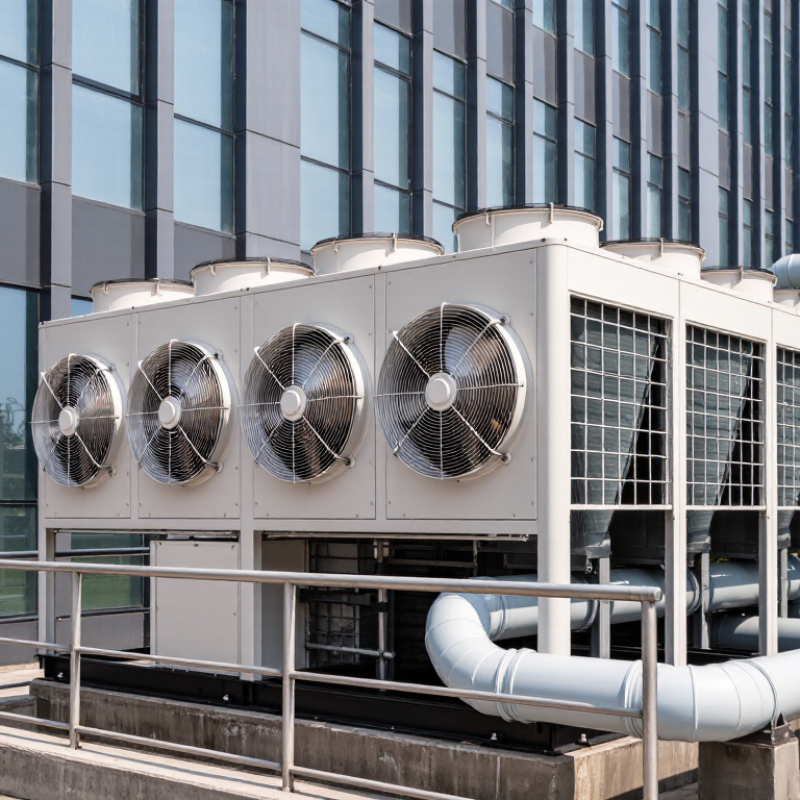
An air-cooled chiller is a machine that removes heat from water and rejects it directly to outdoor air. Pumps carry chilled water through building coils, where it absorbs heat from rooms or equipment. Inside the chiller, refrigerant moves that heat to condenser coils; fans then push outdoor air across them. No cooling tower is needed. You can often spot the condenser fans on a rooftop unit, moving warm air above the building.
The U.S. Department of Energy’s Federal Energy Management Program evaluates chiller efficiency using rated performance measures, while AHRI Standard 550/590 provides a recognized framework for testing water-chilling packages. AHRI’s Integrated Part-Load Value (IPLV) weights performance at four load points: 1% at full load, 42% at 75%, 45% at 50%, and 12% at 25%. That matters because a chiller may spend much of its time below peak demand. These weights are a rating method, not a promise about any one building’s operating hours.
Air-cooled equipment is often practical where water is limited or a cooling tower is hard to maintain. Its trade-off is exposure to outdoor temperature: on a hot afternoon, condenser fans may work harder and efficiency can fall. Dust on coil fins can make things worse. A site assessment should consider climate, noise, service access, and the real cooling load—not just the rated capacity. Small details matter. One overlooked issue is airflow recirculation around crowded rooftop equipment.
The Main Components of an Air-Cooled Chiller
An air-cooled chiller removes heat from water and releases it outdoors. Its main components form a refrigeration loop, while fans move ambient air across the condenser. The exact layout varies, but the core parts are familiar. Small details matter.
The compressor raises the refrigerant’s pressure and temperature. Hot refrigerant then flows through the condenser coil, where outdoor air carries heat away. Axial fans pull or push air across the coil; blocked fins or poor airflow can reduce heat rejection. This part is easy to overlook. The refrigerant cools and condenses into a liquid, then passes through an expansion valve. The valve meters its flow and lowers its pressure.
Inside the evaporator, the low-pressure refrigerant absorbs heat from the chilled-water circuit and boils. A pump circulates that cooled water to air handlers or process equipment, then returns warmer water to the chiller. Sensors and a controller monitor temperatures and adjust operation as demand changes. In the field, readings can be less tidy than a diagram suggests: dirty coils, changing outdoor temperatures, and uneven water flow all affect performance. Not every system uses identical controls, so the equipment documentation is important when checking settings or planning maintenance.
How Refrigerant Absorbs Heat from Chilled Water
In an air-cooled chiller, warm return water passes through the evaporator while cold, low-pressure refrigerant flows on the other side of a metal heat-transfer surface. Heat moves from the water into the refrigerant. The refrigerant boils, changing from liquid to vapor and carrying that heat away. No mixing occurs. Water’s specific heat is about 4.18 kJ/kg·K, a value used in engineering calculations and documented in the ASHRAE Handbook—Fundamentals. This means each kilogram of water needs roughly 4.18 kilojoules of heat removed to cool by one degree Celsius.
The refrigerant’s boiling temperature is kept below the incoming water temperature, allowing heat to flow naturally across the evaporator wall. As the water cools, it leaves to serve building coils; the refrigerant vapor travels to the compressor, then releases heat outdoors at the air-cooled condenser. The simplified diagram can mislead: actual heat transfer depends on flow rate, surface condition, and the temperature difference across the tubes. Small changes matter. AHRI Standard 550/590 evaluates chiller performance at 100%, 75%, 50%, and 25% load points for part-load ratings, reflecting how real cooling demand varies. Operators should compare those ratings with site conditions; a published rating alone cannot predict every installation’s performance.
What Is an Air Cooling Chiller and How Does It Work? — How Refrigerant Absorbs Heat from Chilled Water
Cycle Step
Main Component
What Happens to the Refrigerant
Heat Transfer
Typical Operating Context
1. Heat absorption
Evaporator
Low-pressure refrigerant boils and changes from liquid to vapor.
Heat moves from the returning water into the refrigerant. As the water cools, it leaves the evaporator to serve the building or process.
Chilled-water supply is often designed around 6–7°C, with return water commonly around 11–12°C. Actual setpoints vary by system.
2. Vapor compression
Compressor
The compressor raises the refrigerant vapor’s pressure and temperature.
Electrical energy is added to the refrigerant; heat is not removed from the building at this step.
The compressor must raise refrigerant pressure enough for it to reject heat at a temperature above the outdoor air.
3. Heat rejection
Air-cooled condenser and fans
High-pressure refrigerant releases heat and condenses from vapor into liquid.
Fans move outdoor air across the condenser coil. Heat from the chilled-water load, plus compressor input, is rejected to the air.
Condensing temperature varies with outdoor conditions and equipment design; it is generally higher than the entering outdoor-air temperature.
4. Pressure reduction
Expansion valve or metering device
The liquid refrigerant passes through a restriction, causing its pressure and temperature to drop; some liquid may flash into vapor.
This prepares the refrigerant to absorb heat again in the evaporator.
The metering device regulates refrigerant flow to help maintain the required evaporator conditions.
5. Cycle repeats
Refrigerant circuit and water loop
Cold, low-pressure refrigerant returns to the evaporator, where it absorbs heat from the water again.
The refrigerant circulates in a closed loop, while chilled water carries cooling to the building or process and returns warmer.
Cooling capacity and efficiency depend on factors such as outdoor temperature, water temperatures, load, and chiller controls.
How the heat transfer works: The refrigerant absorbs heat because its pressure is controlled so that it evaporates at a temperature below the water temperature in the evaporator. The temperature figures shown are common design examples, not fixed limits; actual operating values depend on the application and equipment.
How the Chiller Releases Heat into the Outdoor Air
What Is an Air Cooling Chiller and How Does It Work?
How the Chiller Releases Heat into the Outdoor Air
An air-cooled chiller transfers heat from circulating water to the outdoor air. Inside the evaporator, refrigerant absorbs heat from the water, leaving it cooler for the building’s cooling system. The warmed refrigerant then travels to the compressor, which raises its pressure and temperature. At the condenser coil, the hot refrigerant releases heat as fans move outdoor air across the coil. The refrigerant cools and returns to the evaporator. The cycle repeats.
Airflow matters. If the unit sits too close to a wall, or hot exhaust air flows back into its intake, heat removal can become less effective. Dust, leaves, and other debris on the coil can also restrict airflow. On a hot afternoon, the chiller may need to work harder because the outdoor air is already warm. Small details count.
Real sites are rarely perfect. Nearby walls, changing wind, or accumulated dirt can affect performance, even when a unit seems to be running normally. If cooling weakens or operating conditions change, a qualified technician can check airflow, coil condition, and system readings rather than relying on appearance alone.
Common Applications and System Configurations of Air-Cooled Chillers
Air-cooled chillers remove heat from water and reject it outdoors through coils and fans. They are common in offices, hotels, schools, and smaller hospitals, where cooling demand changes throughout the day. In an office, chilled water can serve air-handling units across several floors. Data rooms and light industrial processes also use chillers, but their steady cooling loads need careful capacity planning. That detail matters.
A small building may use one chiller connected to a pump and a buffer tank. Larger sites often install several chillers in parallel, so units can switch on as demand rises. This arrangement can maintain partial cooling during maintenance, though it does not guarantee uninterrupted operation. Variable-speed pumps may reduce energy use when fewer air-handling units need chilled water. Controls must be commissioned properly; otherwise, the equipment may cycle too often.
Outdoor placement shapes performance. Keep clear space around the condenser coils, since blocked airflow can raise operating temperatures and reduce capacity. Rooftops save ground space, while grade-level installations may simplify service access. Noise and hot exhaust also deserve attention near occupied rooms. A tidy layout can still overlook these issues. Local weather, load patterns, and maintenance access should guide the final configuration, not just the equipment schedule.