Choosing the best Chopper Pump begins with the material, not the brochure.
Wastewater, manure, food by-products, and industrial sludge behave differently inside a pump. Fibrous rags can wrap around an impeller. Sand can abrade cutting edges. Thick sludge can overload the motor before flow reaches the target. These details matter.
Grand View Research reports continued growth in the global wastewater pumps market through 2030, driven by stricter treatment needs and aging infrastructure. The report also highlights efficiency and reliability as important purchasing factors. The U.S. Environmental Protection Agency identifies pumping as a major energy consumer in water and wastewater facilities. A poor selection can therefore increase both maintenance and electricity costs.
Jim MSmachine, founder of MSmachine Company, is often quoted in the industry saying, “The pump must be selected for the solids, not just the liquid.” That principle remains practical. A correct Chopper Pump must match solids size, dry-matter content, flow rate, discharge pressure, temperature, and operating hours. Cutting geometry also deserves attention. A unit handling long fibrous material may need a different cutter than one processing abrasive grit.
Field experience adds another warning. Performance tables rarely reproduce a wet well filled with wipes, grease, and unexpected debris. Laboratory figures help, but they cannot remove every risk. This guide compares pump designs, cutter systems, motor arrangements, and service requirements. It also questions a common assumption: the most powerful pump is not always the best pump. The right choice delivers stable flow, manageable energy use, and fewer unpleasant surprises.
What Is the Best Chopper Pump for Your Application?
The best chopper pump starts with a clear duty point, not a catalog headline. Specify the required flow in cubic meters per hour and the total head in meters. Head includes static lift, pipe friction, valves, elbows, and discharge pressure. A pump may reach the stated flow on paper, yet fail when the pipeline becomes longer or partially blocked. Measure the liquid. Do not guess.
Solids size and shape also control the choice. Record the largest hard particle, fibrous material, and likely foreign debris. A five-millimeter grit particle behaves differently from a long rope-like fiber. The cutting system must match the real solids, not an ideal sample. Keep a safety margin, but avoid excessive speed or oversizing. Both can increase wear, power demand, and maintenance.
Viscosity changes the pump’s actual performance. Thick sludge usually needs more torque and may deliver less flow than clean water curves suggest. Check temperature too, because viscosity can shift significantly during operation. In field assessments, engineers often find that the reported solids concentration was too optimistic. That mistake is common. A short test with representative material can reveal more than a polished calculation. I would also review startup conditions, because a pump that handles steady flow may struggle after overnight settling. The duty point should reflect the difficult moments, not only normal operation.

Define the duty point by checking flow, head, solids size, and viscosity.
| Application | Flow | Head | Solids Size | Viscosity |
|---|---|---|---|---|
| Municipal wastewater | 80 m³/h | 30 m | Up to 50 mm | <100 cP |
| Industrial sludge | 45 m³/h | 25 m | Up to 30 mm | 1,000 cP |
| Food-processing waste | 30 m³/h | 20 m | Up to 20 mm | 3,000 cP |
| Dewatering sludge | 25 m³/h | 35 m | Up to 10 mm | 5,000 cP |
The best chopper pump is selected at the actual duty point, not by flow alone. Higher solids loading and viscosity generally require more cutting capacity, torque, and motor power. Confirm the operating flow and total dynamic head, then verify solids size and viscosity against the pump’s performance curve.
What Is the Best Chopper Pump for Your Application?
Evaluate Cutting Demand: Handle Solids from 25 to 150 mm
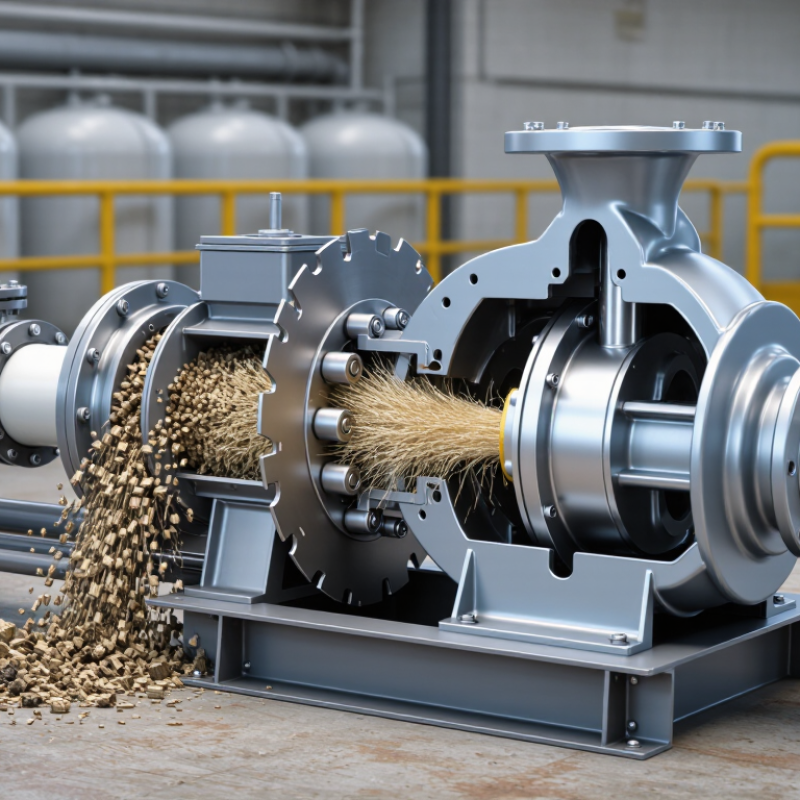
A chopper pump should match the solids, not just the pipe diameter. A 25 mm soft rag behaves differently from a 150 mm fibrous bundle. Measure the blockage risk. Record solids size, material, moisture, and daily loading before choosing the cutting system.
The U.S. EPA’s 2022 Clean Watersheds Needs Survey estimated $630.1 billion in wastewater infrastructure needs over 20 years. That figure highlights a practical issue: aging systems often receive mixed, unpredictable waste. UNESCO’s 2024 World Water Development Report also projects global water demand may rise by 20–30% by 2050. Higher flows can bring more debris into existing pumping stations.
For solids between 25 and 150 mm, inspect cutter clearance, shaft speed, torque, and access for maintenance. A narrow cutting gap may improve reduction, but it can increase wear when grit is present. WEF’s Design of Water Resource Recovery Facilities identifies screenings, rags, and fibrous materials as key equipment-design factors. In the field, I would test representative material, not clean water alone. Fit matters. A 150 mm plastic strip may pass during testing, then wrap around the cutter during continuous operation. That possibility deserves attention. The best selection may require a larger inlet, stronger torque, or a pre-screen. It is easy to over-specify cutting power, yet underestimating rag content is usually the more expensive mistake.
Application-oriented selection guide based on maximum solids size, material characteristics, hydraulic duty, and cutting demand.
| Maximum Solids Size | Typical Material | Cutting Demand | Recommended Pump Configuration | Typical Flow Range | Typical Pressure Range | Suitable Application | Key Selection Considerations |
|---|---|---|---|---|---|---|---|
| 25–40 mm | Screened wastewater, soft organic solids, light fibrous material | Low to moderate; prevent occasional clogging | Compact centrifugal chopper pump with a single cutting stage | 10–60 m³/h | 10–35 m | Small wastewater lift stations, drainage sumps, and light-duty sludge transfer | Prioritize hydraulic efficiency and passage reliability. A moderate cutting edge is usually sufficient when solids are soft and pre-screened. |
| 40–60 mm | Raw sewage, rags, wipes, stringy fibers, and mixed organic debris | Moderate to high; regular fiber cutting required | Centrifugal chopper pump with hardened rotating cutter and stationary shear plate | 20–120 m³/h | 15–50 m | Municipal sewage pumping, wastewater collection systems, and wet wells | Check cutter clearance, motor torque, and clean-out access. Fiber-rich influent may require frequent inspection of the cutting assembly. |
| 60–80 mm | Unscreened sewage, fibrous sludge, food-processing residues, and organic waste | High; repeated cutting under variable loading | Heavy-duty centrifugal chopper pump with replaceable cutters and reinforced wear components | 30–180 m³/h | 20–60 m | Industrial wastewater, sludge transfer, and wastewater treatment plant headworks | Use a motor with adequate starting torque and overload protection. Confirm that the discharge pipeline velocity limits settling and blockage. |
| 80–100 mm | Unscreened municipal sewage, agricultural slurry, crop fibers, and long organic matter | Very high; large solids must be reduced before hydraulic transport | High-torque chopper pump with a multi-stage cutting arrangement and abrasion-resistant wetted parts | 40–250 m³/h | 25–70 m | Large wet wells, agricultural manure transfer, and high-solids process wastewater | Evaluate cutter wear, solids concentration, pump speed, and the risk of wrapping. A bypass or isolation arrangement can simplify maintenance. |
| 100–125 mm | Coarse organic waste, dense manure, fibrous sludge, and mixed biodegradable solids | Extreme; continuous cutting and high torque are expected | Heavy-duty chopper pump with a large inlet, slow-to-moderate operating speed, and replaceable wear parts | 60–350 m³/h | 30–80 m | Large-scale agricultural facilities, anaerobic digestion feed systems, and coarse industrial slurries | Confirm the actual solids size distribution, not only the average size. Specify motor service factor, torque capacity, and access for cutter replacement. |
| 125–150 mm | Very coarse untreated sewage, heavy agricultural slurry, and large fibrous organic solids | Extreme; maximum cutting capability and robust torque transmission are essential | Engineered heavy-duty chopper system, often with upstream screening or a dedicated maceration stage | 80–450 m³/h | 35–90 m | Large treatment facilities, bulk slurry transfer, and demanding waste-handling installations | Use a site-specific duty assessment. Verify pump capacity, cutter metallurgy, wear allowance, solids concentration, and emergency blockage procedures. |
Important: Flow and pressure values are indicative selection ranges, not guaranteed performance ratings. Final pump selection should be based on the actual total dynamic head, solids concentration, particle shape, viscosity, temperature, pH, abrasion level, operating hours, and required reliability.
A suitable chopper pump should operate near its best efficiency point, not merely pass solids. The Hydraulic Institute recommends sizing rotodynamic pumps within approximately 70–120% of BEP. This range helps control vibration, radial loading, recirculation, and seal stress. A pump selected only by discharge size may run far from BEP. That mistake can increase wear quickly.
Start with the real operating data. Record flow, total dynamic head, liquid temperature, solids concentration, particle size, and suction conditions. Then compare the system curve with the pump curve.
The U.S. Department of Energy’s Improving Pumping System Performance sourcebook reports that pumping systems can represent about 25% of electricity used by industrial motor-driven systems. Small hydraulic errors can become expensive over time. Especially in wastewater duty.
Chopper pumps face an additional problem: solids are not always consistent. Fibrous material may wrap around cutting components, while grit can accelerate erosion. Keep the duty point inside the 70–120% BEP window after accounting for seasonal flow changes. Check NPSH margin, motor loading, and shutdown conditions. Field measurements may disagree with design assumptions. That is normal, but ignoring the difference is not. The best selection may require a smaller impeller, a different speed, or a revised control strategy. BEP is a guide, not a guarantee. Real systems rarely remain perfectly centered.
Match Materials to pH, Chlorides, and ASTM A532 Wear Resistance
The best chopper pump starts with the liquid, not the motor size. Record pH, chloride levels, temperature, solids, and cleaning chemicals. Small details matter. A mildly acidic slurry may attack ordinary carbon steel over time. Chlorides can accelerate pitting, especially near welds and stagnant zones.
Select wetted materials for the actual chemistry. Acidic service may require corrosion-resistant alloys or carefully selected stainless steel. However, stainless steel is not automatically safe in high-chloride conditions. Test data and operating temperature should guide the decision. Plastics or elastomers may also need review when chemicals cause swelling, cracking, or hardening.
Abrasion creates a separate challenge. Sand, grit, ash, and mineral particles can quickly damage cutting edges and pump casings. ASTM A532 wear-resistant iron can improve service life in suitable abrasive applications. Its performance depends on the correct grade, hardness, impact conditions, and casting quality. Harder is not always better. Excessive hardness can reduce toughness.
Check the solids before choosing the material. Fibrous waste may need sharp, replaceable cutters. Grit-heavy slurry may favor sacrificial wear parts and easier inspection. A practical installation should include flush points, access covers, and pressure monitoring. Do not overlook maintenance records. They often reveal the real failure pattern.
Material selection still involves compromise. A corrosion-resistant part may wear faster than expected. A very hard part may crack under impact. Pilot testing is worthwhile when chemistry changes seasonally. That assumption can fail.
What Is the Best Chopper Pump for Your Application?
A chopper pump must pass more than a solids test. Verify installation using NPSH, motor load, and speed data. Hydraulic Institute guidance identifies NPSH3 as a standardized cavitation reference, not a complete field safety margin. Measure liquid temperature, suction pressure, and actual flow. A flooded suction line may still perform poorly if the inlet is undersized or partially blocked.
At 1,450–1,800 rpm, small speed changes can strongly affect pump demand. The affinity laws show that flow follows speed, head follows speed squared, and power follows speed cubed. An increase from 1,450 to 1,800 rpm can raise theoretical power demand by roughly 90 percent. Real systems vary, especially with fibrous waste and changing viscosity. The U.S. Department of Energy’s Improving Pumping System Performance sourcebook notes that pumping systems can represent nearly 25 percent of industrial electricity use. Motor current therefore deserves daily attention, not occasional inspection.
Tips: Record suction pressure, discharge pressure, rpm, amperage, and flow during commissioning. Compare amperage with the motor nameplate service factor. Keep at least 10 percent practical NPSH margin where operating conditions fluctuate, but confirm the value with the manufacturer’s test curve. I have seen installations pass a dry workshop test yet overload in service. That usually means the data was incomplete, or the system was treated as ideal. Recheck the inlet, impeller clearance, and control settings before increasing speed.