

China’s COB LED strip light manufacturers serve projects ranging from narrow retail display cases to long hotel corridors. Yet a bright sample tells only part of the story. Buyers also need to assess color consistency, heat management, dimming compatibility, adhesive performance, and the quality of the power supply.
The International Energy Agency has estimated that lighting accounts for about 15% of global electricity consumption, making efficiency more than a marketing claim. The U.S. Department of Energy states that LEDs “use at least 75% less energy, and last up to 25 times longer, than incandescent lighting.” Those figures describe LEDs broadly, not every COB LED strip light. Product performance still depends on the complete system and its installation.
LED pioneer Shuji Nakamura’s work on blue LEDs helped make efficient white LED lighting practical. For COB strip buyers, that history is a reminder: the chip matters, but so do engineering and production control. We could not verify a direct Nakamura quotation about COB strips, so attributing one would be misleading. This guide compares leading Chinese manufacturers by product range, technical documentation, customization, quality practices, and export support. Ask for test reports and samples. A warm white sample under a showroom lamp may look excellent; the same strip can reveal uneven color on a long ceiling run. Small differences matter.
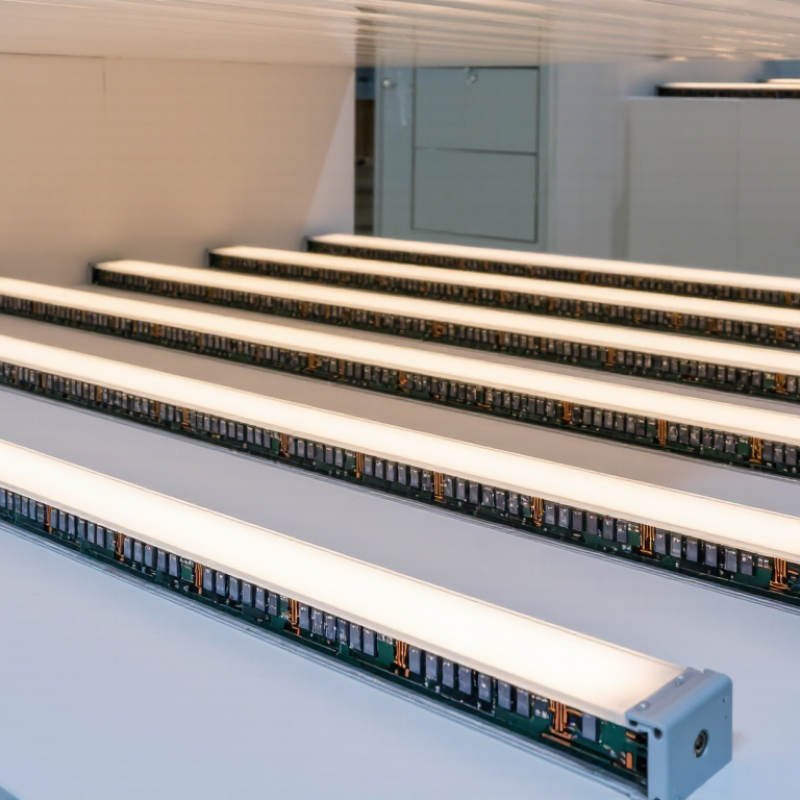
COB (chip-on-board) LED strips place many small LED chips close together on a flexible circuit board. A continuous phosphor layer diffuses their output, making the strip appear as a smooth line rather than separate bright dots. Current flows through copper traces, while the board helps spread heat toward its backing. Light quality still depends on the layout and proper heat removal. Not magic.
COB strips are commonly classified by color output, voltage, width, and protection level. Single-color versions provide fixed white or colored light. Tunable-white types combine warm and cool emitters, while RGB versions mix red, green, and blue. Check the cut marks and supply voltage before installation. IP ratings indicate resistance to dust and water, but do not mean every strip is suitable for immersion. Compare color rendering, power use per meter, and dimming compatibility, too. Product labels can be confusing.
Tips: Test a short sample under the actual cabinet before buying a full roll. Check for uneven color and excess warmth after several minutes. I would not rely on product photos alone; diffuser depth can change the result.

When evaluating Chinese COB LED strip manufacturers, look beyond product photos. Request a datasheet showing power consumption, input voltage, color temperature, color-rendering index, and cutting intervals. Check whether the stated output is measured consistently across production batches. Ask how the manufacturer controls color variation between reels; visible differences can appear when strips run side by side.
Review the production process and the evidence behind quality claims. Ask about copper thickness, adhesive type, LED encapsulation, and thermal testing. A supplier should explain how samples are tested for brightness, color consistency, and heat buildup, not merely provide a certificate. Compare a production sample with its datasheet, and request clear warranty terms and traceable inspection records. A polished sample is useful, but it cannot prove every batch will match. No checklist catches everything.
Tips: Test a full reel under your actual power supply and mounting conditions. Note brightness at the far end, adhesive grip on a clean metal surface, and color after several hours. Keep photos and readings. Small gaps in documentation deserve follow-up, even when the answers seem reasonable.
Suggested evaluation weights for comparing suppliers. These are a practical assessment framework, not results from an industry survey; adjust them to suit your project requirements.
How to use it: Score each supplier against the same criteria, using product datasheets, sample testing, certifications, and written warranty terms. The percentages indicate suggested importance and total 100%.
Profiles of leading COB LED strip light manufacturers in China should be judged by engineering evidence, not catalogue claims. The IEA’s Energy Efficiency 2023 report estimates that lighting uses about 15% of global electricity. That makes efficacy and thermal control practical buying criteria. Compare measured lumens per watt, color consistency, and output after extended operation. Ask for test reports with stated voltage, temperature, and measurement method. Details matter.
Strong manufacturers can explain how chip spacing, phosphor coating, and flexible-circuit design affect the continuous, dot-free line of light. Request samples in the intended color temperature, then inspect them in a dim room and around tight bends. Check solder pads, adhesive backing, and brightness uniformity across the reel. Consistency matters. The U.S. Department of Energy notes that LEDs can use at least 75% less energy than incandescent lighting, but strip performance still depends on installation and heat management. One gap in many supplier profiles is limited long-term field data. Treat short sample tests as useful, not conclusive, and verify warranty terms and production traceability before ordering.
A name-free comparison of product capabilities and sourcing considerations commonly used to evaluate COB LED strip manufacturers. Product specifications vary by model and should be confirmed in the supplier’s current datasheet.
| Profile Area | Relevant Product or Manufacturing Information | What Buyers Should Verify |
|---|---|---|
| COB construction | COB strips place closely spaced LED chips on a substrate beneath a continuous phosphor layer. This construction is designed to create a more continuous line of light than widely spaced, individually visible LED packages. | Request a lit sample and check for visible dark spots, color variation, and consistency along the strip. |
| Operating voltage | 12 V and 24 V DC are common options in low-voltage strip lighting. The appropriate supply depends on the strip model, installation length, and power requirement. | Confirm the rated voltage, watts per metre, maximum recommended run, and compatible power supply for each SKU. |
| LED density and cut interval | Chip density and cutting points are design-specific. The cut interval is determined by the electrical layout of the PCB; there is no single interval that applies to all COB strips. | Check the datasheet for chips per metre, cut marks, minimum segment length, and the effect of cutting on warranty. |
| Color temperature and color options | Single-color white strips are offered in different correlated color temperatures. Some product ranges also include tunable-white or colored-light variants, depending on the design. | Confirm the available CCT or color range, binning information, and whether the requested variant is available at the required voltage and density. |
| Color rendering | Color rendering is model-dependent; COB strip product ranges may include different CRI options. A high CRI value should not be assumed from the COB construction alone. | Ask for the tested CRI value and, where color accuracy is important, supporting test data for the exact model. |
| PCB dimensions and flexibility | Strip width, copper design, substrate, and bend characteristics vary by product. These features affect fit, heat management, and installation in channels or narrow spaces. | Request a dimensioned drawing and confirm strip width, thickness, bending direction, and installation surface requirements. |
| Environmental protection | Products may be supplied with different levels of protection, from uncoated indoor versions to coated or enclosed versions. Protection depends on the complete assembly and is not determined by COB technology alone. | Verify the stated IP rating and test documentation for the finished strip, connectors, and any supplied accessories. |
| Dimming and control | Dimming compatibility depends on the strip’s electrical configuration and the selected controller or power supply. Some products support single-channel dimming; multi-channel color variants require compatible control equipment. | Test the strip with the intended controller and power supply, including dimming range, flicker performance, and wiring requirements. |
| Thermal and electrical testing | Operating temperature, voltage drop, power consumption, and thermal behavior are product-specific performance characteristics that can be assessed through product testing. | Request the model-specific datasheet and test reports, and evaluate performance under the intended installation conditions. |
| Compliance documentation | Applicable compliance requirements depend on the destination market and the product configuration. Documents for one model or component do not automatically establish compliance for every finished product. | Check that certificates and test reports identify the exact model, components, and destination-market requirements. |
| OEM and customization | Potential customization areas include strip length, connector arrangement, packaging, labeling, and selected electrical or optical specifications. Availability and minimum order quantities vary by supplier and model. | Obtain written confirmation of customization scope, sample approval, tooling or setup costs, minimum order quantity, and production lead time. |
| Supplier profile assessment | A useful manufacturer comparison considers product range, documented quality controls, sample consistency, customization process, and export documentation rather than relying on a product listing alone. | Compare the same specification across suppliers and verify factory, quality, and delivery claims during due diligence. |
Note: This table presents general product and sourcing facts, not verified company-specific specifications or rankings. Confirm all technical and compliance details with the manufacturer for the exact product model.
Comparing COB LED strip manufacturers in China starts with the product range, not a glossy catalogue. Check available widths, LED density, color temperatures, voltage options, and waterproof constructions. Request a sample. Inspect light continuity at close range; visible dots or uneven color can reveal limits hidden in photos.
Certifications matter, but their scope matters more. Request current test reports and confirm that model numbers match the strip you plan to buy. Depending on the destination market and product configuration, relevant documents may cover electrical safety, electromagnetic compatibility, or material compliance. Do not treat a certificate for one product family as proof for every version. Paperwork is not performance.
Customization can include cut lengths, connector types, adhesive backing, color consistency targets, packaging, and reel labeling. Discuss minimum order quantities, tooling costs, and sample lead times before approving artwork or a production schedule. Ask how color bins are controlled across batches and what inspection records are available. Small details count. It is easy to overvalue a detailed specification, though. A physical sample and clear acceptance criteria still matter, even under deadline pressure.
China’s COB LED strip industry is shifting from basic brightness toward smoother light, tighter color control, and easier installation. COB packages place many small LED chips close together, creating a continuous line with fewer visible dots. This suits shallow display cabinets, curved coves, and narrow retail shelves. But dense chips also concentrate heat. Aluminum channels and sound thermal design still matter.
Energy performance remains a strong market driver. The International Energy Agency’s Energy Efficiency 2017 report estimated that lighting used about 15% of global electricity. The U.S. Department of Energy notes that LED products can use at least 75% less energy and last up to 25 times longer than incandescent lighting. These figures are not COB-specific, but they help explain demand for efficient strip systems. Buyers are also asking for stable color temperature, high color rendering, and dimming without visible flicker.
Smart controls and flexible installation are gaining attention, especially in hospitality and display projects. Yet more features do not guarantee better results. A weak point remains. Datasheets may show impressive output, while real performance changes with strip length, supply voltage, and heat buildup. Manufacturers that publish test conditions, bending limits, and output data make comparisons more useful. Careful sample testing is still worthwhile.