Top Air Source Heat Pump Manufacturers for Global Buyers

Choosing an Air Source Heat Pump manufacturer is a practical decision, not just a search for the lowest quoted price. Buyers must compare output at local design temperatures, seasonal efficiency, noise levels, warranty terms, and access to replacement parts. A unit that performs well in a mild test climate may behave differently through a damp winter or repeated frost cycles. Details matter.

The International Energy Agency’s The Future of Heat Pumps report recorded an estimated 11% rise in global heat pump sales in 2022. Sales in the European Union grew by nearly 40% that year, reflecting stronger policy support and high energy prices. These figures describe a specific period, not a guaranteed forecast. Markets have since shifted, so buyers should check recent regional data before making procurement decisions.

This guide introduces manufacturers serving international markets and explains what global buyers can assess beyond brand recognition. Compare published performance data under relevant test conditions, installation guidance, refrigerant options, and the strength of local service networks. Ask how suppliers handle commissioning and warranty claims across borders. Ask for evidence, not promises. Product specifications can be difficult to compare when test methods differ, and a polished brochure cannot replace field experience. That is worth remembering. The most suitable supplier may depend less on headline capacity than on climate fit, installer skill, and dependable support after delivery.
Top Air Source Heat Pump Manufacturers for Global Buyers

How Air Source Heat Pumps Work and Where They Are Used

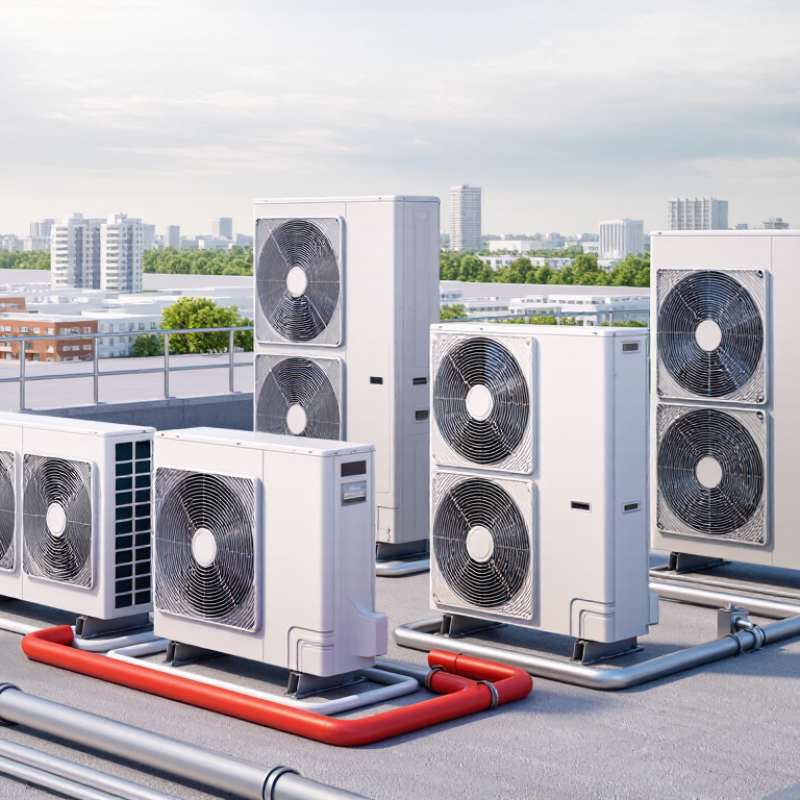
An air source heat pump transfers heat between outdoor air and a building. A fan pulls air across an evaporator, where refrigerant absorbs heat and changes into vapor. A compressor raises the vapor’s pressure and temperature. The hot refrigerant then releases heat indoors through a coil.

It is not combustion. In summer, a reversing valve can switch the cycle, moving indoor heat outside for cooling.

The International Energy Agency’s 2022 report, The Future of Heat Pumps, says heat pumps can deliver three to five units of heat for each unit of electricity they consume.

The same report estimates they supply around 10% of global building heating needs.

Homes use them for room heating and, with suitable equipment, hot water. Offices, shops, and some industrial sites also use them, especially where heating and cooling are both needed.

Installation details matter. A unit beside a bedroom window may create noticeable fan noise, while poor insulation can increase heating demand. In cold weather, the pump may need to work harder, and some systems use backup heat during peak demand.

Seasonal efficiency depends on climate, sizing, controls, and installation quality. The headline efficiency figure is useful, but it does not predict every building’s energy bill.
How to Assess Manufacturers for Global Purchasing

Top Air Source Heat Pump Manufacturers for Global Buyers

How to Assess Manufacturers for Global Purchasing

A reliable assessment starts with operating conditions, not brochure claims. Compare heating capacity and efficiency at the outdoor temperatures your project will actually face. A unit rated at mild temperatures may behave differently during a frosty morning. Ask for independent test reports, performance tables, and clear definitions of each rating condition. Check whether the proposed model fits your building’s heat loss and water-temperature needs. A mismatch can mean higher energy use or uneven indoor comfort.

Tips: Request a sample performance report. Verify the test conditions, noise data, warranty terms, and availability of common replacement parts. Ask who handles technical support across your time zones.

Then examine manufacturing consistency. Request details about production checks, leak testing, and how faults are recorded and corrected. If possible, review a recent factory audit or arrange a video inspection of the assembly and testing areas. Confirm that manuals, wiring diagrams, and commissioning guidance are complete and understandable. Ask for references from buyers with similar climates and installation needs. Be cautious if answers arrive without evidence. A spreadsheet can make suppliers look easy to compare, but I would not treat a polished document as proof; practical service arrangements deserve equal scrutiny.

Leading Manufacturers by Region and Market Focus

Air source heat pump manufacturers often shape their products around local climates, building styles, and installation practices. In Europe, many suppliers focus on cold-weather performance, compact outdoor units, and integration with hydronic heating. In East Asia, manufacturers commonly serve dense housing markets, where quiet operation and space-saving designs matter. North American producers often address larger homes, ducted systems, and wide temperature swings. These are broad patterns, not strict rules.

For global buyers, market focus can matter as much as production capacity. A manufacturer experienced with coastal conditions may understand corrosion-resistant finishes, while one serving renovation projects may offer controls suited to older heating systems. Ask for verified performance data at your expected outdoor temperature, not only headline efficiency figures. Check spare-parts access and local technician training, too. Regional labels can help, but they do not tell the whole story.

Tips: Compare operating range, sound levels, and service support for the exact model. Request references from projects in similar climates. Be cautious when comparing figures measured under different test conditions. Even a strong specification sheet can miss practical installation issues.

Top Air Source Heat Pump Manufacturers for Global Buyers - Leading Manufacturers by Region and Market Focus

Regional overview of established manufacturing strengths and market requirements. This is not a company ranking; capabilities vary by manufacturer and product line.

Region Common manufacturing strengths Typical product focus Primary market focus Buyer checks
China Large-scale HVAC and heat-pump production, broad component supply chains, and a wide range of system configurations. Air-to-water and air-to-air systems, including residential and light-commercial models. Domestic installations and export markets across multiple price and capacity segments. Check independent performance data, local certifications, refrigerant requirements, spare-parts support, and warranty coverage in the destination market.
Japan Longstanding expertise in residential air conditioning, inverter controls, and compact equipment design. Residential air-to-air heat pumps and compact systems designed for efficient part-load operation. Domestic and export residential markets, with product configurations adapted to local climates and building practices. Confirm heating output at low outdoor temperatures, defrost behavior, local service availability, and compatibility with the building’s distribution system.
South Korea Established electronics and HVAC supply chains, with experience in electronically controlled and connected equipment. Residential and light-commercial air conditioning and heat-pump systems. Domestic and international markets, including applications where controls and system integration are important. Review published seasonal efficiency ratings, control-system compatibility, cybersecurity and connectivity policies, and local technical support.
Europe Strong focus on hydronic heating, system integration, and products designed for regional efficiency and refrigerant rules. Air-to-water systems for space heating and domestic hot water, including models intended for retrofit projects. Residential and commercial heating markets, especially where heat pumps connect to radiators, underfloor heating, or hot-water tanks. Check performance at the required flow temperature, compatibility with existing emitters, refrigerant compliance, and applicable product certification.
North America Experience in ducted residential HVAC, split systems, and equipment designed for a broad range of heating and cooling conditions. Air-to-air split and ducted heat pumps, with cold-climate models available in the market. Residential replacement and new construction, with demand influenced by regional climate, electricity prices, and incentives. Verify capacity and efficiency at the local design temperature, duct compatibility, recognized ratings, installer training, and refrigerant transition plans.

Note: Regional descriptions indicate broad industry patterns, not the capabilities of every manufacturer. Compare model-specific test results and local compliance documentation before purchasing.

Product Lines, Efficiency Ratings, and Certifications

Global buyers should compare complete product lines, not just a manufacturer’s flagship unit. Common options include monobloc and split systems, with different capacities, control packages, and domestic hot-water configurations. A compact unit may suit a small home, while a larger property may need staged capacity or multiple units. Check the operating range against local winter temperatures and the required water flow temperature. Installation details matter, too: a monobloc’s water connections outdoors need careful freeze protection. The brochure may not make that obvious.

Efficiency ratings need context. COP describes performance at a specific test condition; seasonal ratings such as SCOP better reflect changing temperatures, but test climates differ. Compare models under the same rating method, and note the stated flow temperature, defrost assumptions, and standby consumption. A high number alone can mislead. Noise and output at low temperatures deserve attention as well. Ask for test reports tied to the exact model, not a similar unit in the same range. Certifications can cover safety, performance, and regional market requirements, but acceptance varies by destination. Paperwork matters. I would still verify certificate scope and expiry directly; supplier summaries can leave gaps.

Comparing Service, Warranty, and Supply Capabilities

For global buyers, an air source heat pump is only as dependable as the support behind it. Compare manufacturers by asking who handles commissioning, troubleshooting, and replacement parts in your region. A clear service route matters. Ask for typical response times, local technician coverage, and support hours across time zones. Then check whether installation guidance includes water-flow settings, defrost behavior, and cold-weather operation. These details can prevent avoidable delays when a system reaches a busy site.

Warranty terms deserve close reading. Compare coverage for the compressor, controls, and other major components, along with labor, shipping, and exclusions. A long warranty may offer little value if claims require hard-to-find records or parts must travel for weeks. Request the claim process in writing. Also ask how serial numbers, commissioning reports, and maintenance records should be kept. Supply capability is more than advertised production volume; ask about current lead times, export packaging, spare-parts stock, and how delays are communicated. A supplier’s answer should be specific, not merely reassuring. Some comparisons remain imperfect: shipping conditions, installer skill, and seasonal demand can change the outcome. Record these uncertainties before choosing.